
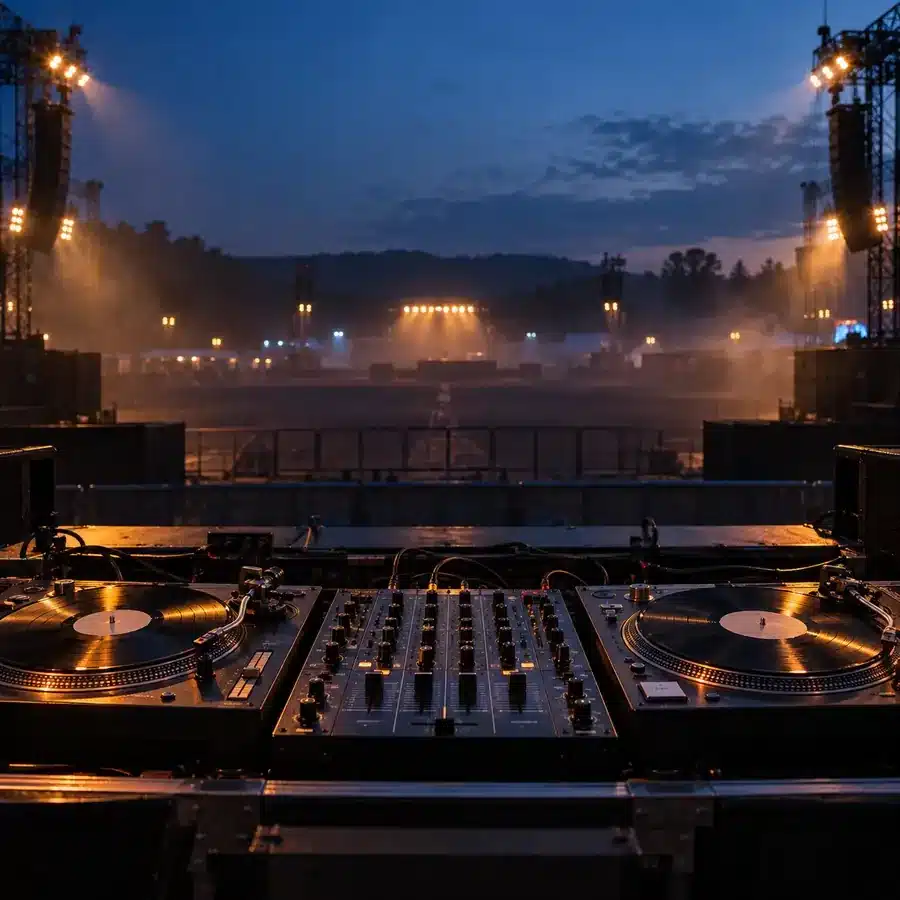
A DJ set is not simply a row of tracks. It is a sequence of decisions: when to hold tension, when to release it, which records belong together and how long a transition should be allowed to breathe.
On 9 October, Spotify gave that sequence a more permanent home. The platform released selected performances from San Francisco’s Portola Music Festival, including what it describes as its first longform video DJ sets.
The initial selection includes Chloé Caillet, Beltron b2b Ben Sterling, Groove Armada, Max Styler, Four Tet, Zara Larsson, Brunello and Fcukers, with sets from Marlon Hoffstadt and VTSS due to follow. For electronic music, the important part is not only that the performances were filmed. It is that Spotify is presenting the uninterrupted set inside the same service that already holds the individual tracks.
That turns a festival appearance into something closer to a catalogue object.
The Set Is the Work
Streaming platforms are designed around discrete recordings. Every song has a title, artist, duration and position in a catalogue. A DJ set behaves differently.
Its meaning sits between the tracks as much as inside them. Two familiar records can feel new when their rhythms overlap. A slow build may only make sense because of what happened twenty minutes earlier. The crowd, lighting and physical scale of the room also shape how the music lands.
Short clips can capture a dramatic drop or a burst of audience energy. They rarely explain the route that made the moment effective. Longform video preserves more of that route. It lets a viewer follow pacing, selection and transitions instead of consuming the performance as a collection of highlights.
This matters particularly in electronic music, where performance is often misread as the playback of finished recordings. A complete set makes the creative act easier to see. Curation becomes composition in real time.
From Event Memory to Repeat Listening
Portola took place last month at Pier 80 in San Francisco. Spotify served as the festival’s official music and video partner, extending an existing relationship that had included playlists and on-site installations.
The new video hub gives selected performances a second life after the physical event. Someone who attended can revisit the night. Someone who was elsewhere can encounter the set without pretending that a phone clip recreates the entire experience.
That distinction is useful. The video is not the festival, but it can become its own way of listening.
Earlier this month, I wrote about why a live-only festival stream can gain meaning from disappearing. Portola presents the opposite editorial choice. These performances are valuable because they remain available and allow the audience to return.
Both approaches can work. A temporary broadcast concentrates attention around a shared clock. An archive lets a performance accumulate meaning over time. The decision should follow the character of the event rather than a rule that everything must vanish or everything must stay.
Video Is Moving Closer to the Music Catalogue
Spotify has spent much of 2026 expanding full-length video. In June, Spotify for Artists opened a beta that allows participating artists to upload official music videos, live performances, studio sessions and covers directly.
The Portola collection moves beyond that song-by-song model. Spotify’s upload guidance says multi-song concerts are not supported in the artist beta. The festival sets therefore represent a different kind of platform release: a curated partnership built around an extended performance rather than one recording.
That difference should not be blurred. Spotify says eligible full-length videos uploaded through the artist beta can generate royalties and may count towards charts. Its Portola announcement does not explain how these multi-song sets are licensed, credited or paid. Artists and labels should not assume that the same rules apply.
Still, placing a complete DJ set beside albums and playlists changes the listener’s route. The performance no longer lives only on a general video platform or in scattered social clips. It appears where the listener can move directly into the artists’ recorded catalogues.
Electronic Music Needs Continuity
Electronic music often works through duration. A track may be built for a particular point in a night, a tempo range or a transition that reveals a different side of it. The isolated recording remains important, but the set shows what the track can do in relation to other music.
That idea also matters away from clubs. Tempo Syndicate builds cinematic electronic music around movement, focus and carefully chosen tempos. A runner may experience those tracks as part of a continuous physical journey rather than as unrelated singles. The context changes what the music is for.
A festival DJ set demonstrates the same principle at another scale. Sequence can turn separate recordings into a sustained environment. Preserving the set gives listeners a chance to understand that larger shape.
The artist reference is not a claim that every electronic project should make hour-long videos. It is a reminder that electronic music is frequently designed around flow. Platforms built around individual tracks need formats that can respect it.
The Archive Still Needs Editorial Care
Longform availability does not automatically create value. An unedited recording with weak sound, unclear credits or no useful route into the music can become another item people intend to watch later.
A durable set needs context. Viewers should know who performed, where and when it happened, which artists and tracks appear, and where they can continue listening. Accurate track identification matters because discovery should reach the people whose music created the set.
Rights also become more complex as the performance moves from a fleeting event to an on-demand object. A DJ set can contain recordings from many artists, writers, labels and publishers. The visual performance adds another layer of permissions and presentation. A platform partnership can coordinate that work, but independent artists should plan it before cameras begin rolling.
The safest lesson is therefore not “film every show.” It is to decide what the recording is meant to become.
A live clip may introduce the atmosphere. One complete set may reward committed listeners. A tracklist can open discovery paths. An edited audio version might become a separate release only when the necessary rights and agreements are clear.
A Performance Can Join the Catalogue Without Becoming a Track
Portola’s longform videos suggest that streaming services are beginning to treat performance as more than promotional material around a recording.
That is a subtle but important shift. The set does not need to be broken into isolated moments to fit the platform. It can remain a set: continuous, paced and shaped by the relationship between records, performer and room.
For listeners, this creates a slower form of discovery. One artist can lead to another through a transition rather than a recommendation tile. A track can be understood through what surrounds it. A festival memory can keep unfolding after the site has been cleared.
The individual song remains the foundation of the streaming catalogue. But electronic music has always known that the space between songs can carry meaning too.
Now the platform is beginning to make room for that space.