
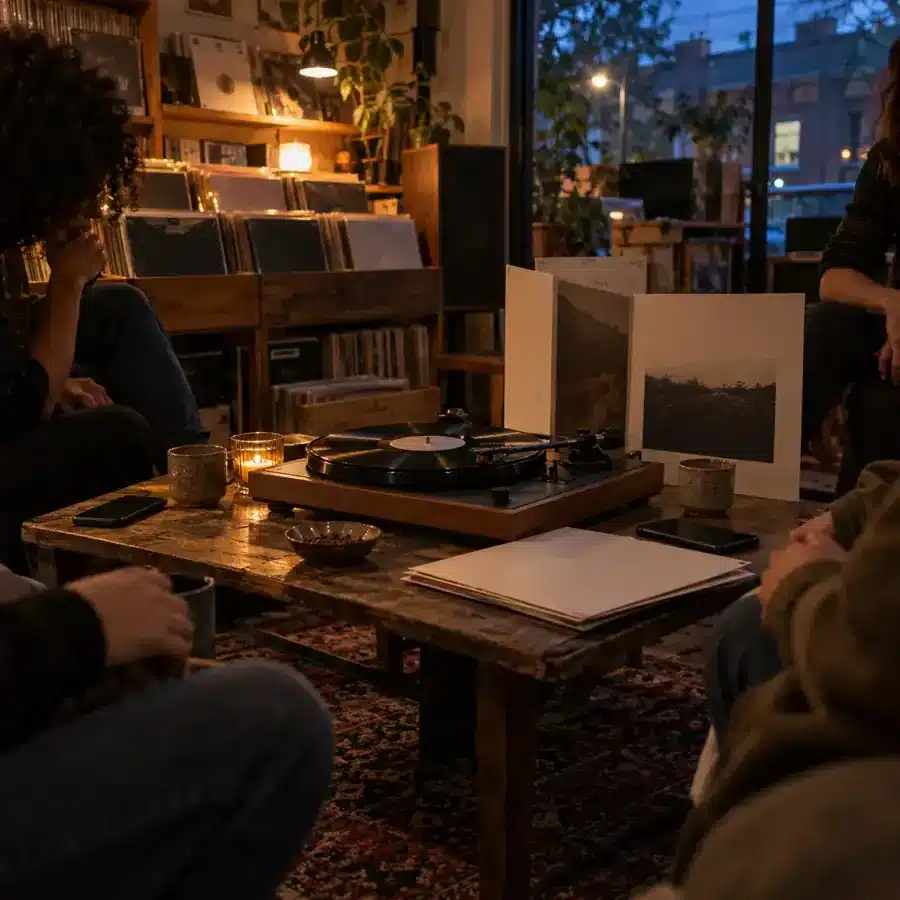
The album has spent years competing with the convenience of the next song.
A listener can move from a recommendation to a playlist, then into another artist’s catalogue without ever deciding to hear one record from beginning to end. That freedom is one of streaming’s great strengths. It also means an album release can arrive everywhere at once and still struggle to feel like an occasion.
This weekend offered a useful counterpoint. National Album Day returned in the UK on 17 October with more than 85 reissues and new releases, alongside activity in record shops and online. Meanwhile, Bandcamp’s current calendar is full of artists inviting listeners to hear complete records together in real time.
The two developments are not identical. One celebrates the album as a cultural form; the other gives artists a practical release tool. Together, they suggest that the album is not disappearing. It is becoming an event again.
Attention Changes When the Music Has a Start Time
Most digital releases are built around permanent availability. The music appears at midnight and remains ready whenever the listener chooses to arrive. That is convenient, but it removes the small pressure that makes an event feel important.
A listening party restores a beginning. People know when the first track will play. They hear the same sequence at roughly the same moment. The artist can explain a lyric, production choice or transition while the detail is still audible. The audience is no longer a collection of anonymous plays spread across several weeks; for an hour, it is a room.
Bandcamp’s format makes that structure explicit. At showtime, the album plays once from beginning to end. The full tracklist and liner notes remain visible, artists can join a live chat, and listeners can pre-order or buy the release without leaving the event.
None of those functions is technically dramatic. Their value comes from how they organise attention.
The Sequence Becomes Part of the Story
Streaming did not abolish track order, but it made sequence easier to ignore. A song can leave its album immediately and travel through playlists, radio features, short-form clips and personal queues. That movement can introduce an artist to far more people than the complete record reaches.
The problem begins when the campaign treats every track as an isolated opportunity. An album has another kind of meaning: tension created across several songs, a change of pace at the right moment, an opening that establishes a world and a final track that closes it.
A shared first listen asks the audience to notice those relationships. The artist does not need to insist that listeners reject playlists or consume music in one approved way. It is enough to create one moment in which sequence matters.
That distinction is visible in Night Runner by Tempo Syndicate. Its ten tracks move from a controlled opening stride through harder intervals and towards a cool-down. Individual tracks can work inside running playlists, but the full order describes a physical arc that no single song can carry alone. A listening event would give that arc space to register before the tracks begin their separate lives.
Physical Music and Digital Gatherings Answer the Same Need
National Album Day is closely connected to record shops, reissues and collectable editions. It would be easy to read that celebration as nostalgia for a time before streaming. The market suggests something more interesting.
IFPI reported that global physical-format revenue grew by 8 per cent in 2025. Vinyl revenue rose by 13.7 per cent, marking its nineteenth consecutive year of growth. Streaming remained much larger, accounting for 69.6 per cent of global recorded-music revenue, so the point is not that physical media is replacing access.
Physical releases give music boundaries. There is an object, a side, a sleeve, a reason to begin and a visible place to return. A digital listening party can create some of the same focus without asking every listener to own a turntable or live near a participating shop.
Both formats turn listening into a deliberate act. One uses an object; the other uses a shared time.
Independent Artists Do Not Need a Large Audience to Make It Work
The phrase “release event” can sound too ambitious for an artist with a modest following. In practice, a small group may be an advantage.
Ten attentive listeners who ask questions, remember a song and tell someone else can matter more than a large number of passive impressions. A small event also allows the artist to respond personally rather than performing a generic launch script.
The useful measure is not whether the chat looks busy enough for a screenshot. It is whether the event deepens the relationship around the music. Did listeners stay through the record? Which songs prompted questions? Did anyone buy, pre-order, save or return later? Did the artist learn which part of the album’s story people understood?
Those signals are especially valuable for independent labels. They reveal more than raw reach because they show where attention turns into curiosity, conversation or support.
A Listening Party Needs More Than a Link
Scheduling the stream is the easy part. The event becomes worthwhile when the invitation gives people a reason to attend live.
The artist might share how the album’s sequence changed, play an early version of one track, explain the artwork or answer questions after the final song. A label can prepare a short set of prompts without scripting every response. The aim is not to speak over the record. It is to add details that make the music more memorable.
Timing also matters. A pre-release session can reward committed followers and support pre-orders. A release-night event can concentrate attention when the record becomes available. A later gathering can revive a campaign once the first burst of posts has passed.
The invitation should be clear about which kind of moment it is. Listeners need the time zone, the expected length, the listening link and an honest description of what will happen. A calendar reminder is more useful than a week of vague countdown graphics.
The Event Should Lead Somewhere
A good listening party does not end when the final track stops. It gives the audience a simple next step.
That might be buying the record, saving the album, joining a mailing list, following the artist, ordering a limited edition or attending a release show. The choice should fit the release rather than turning the evening into a stack of competing calls to action.
Artists can also preserve some of the context afterwards. A thoughtful answer from the chat might become a short note about the record. A production detail could support a later video. The questions listeners ask may reveal which parts of the album deserve a deeper story.
What should remain unrepeatable is the feeling that people chose to be present together. Recording and repackaging every second can weaken the very intimacy the event creates.
The Album Does Not Need to Win an Argument
The album is sometimes defended as though listeners must choose between serious, complete works and a distracted culture of individual tracks. That argument is unnecessary.
A song can travel independently and still belong to a carefully shaped record. A playlist can introduce the artist; a listening party can reveal the larger world. Physical editions can serve collectors while the same album remains instantly available to everyone else.
National Album Day and Bandcamp’s active schedule of listening parties point towards the same possibility: people still value complete records when they receive a reason to gather around them.
For an independent artist, the opportunity is not to demand an hour of attention from the whole internet. It is to invite the right listeners into one well-made hour—and make the album feel present while they are there.