
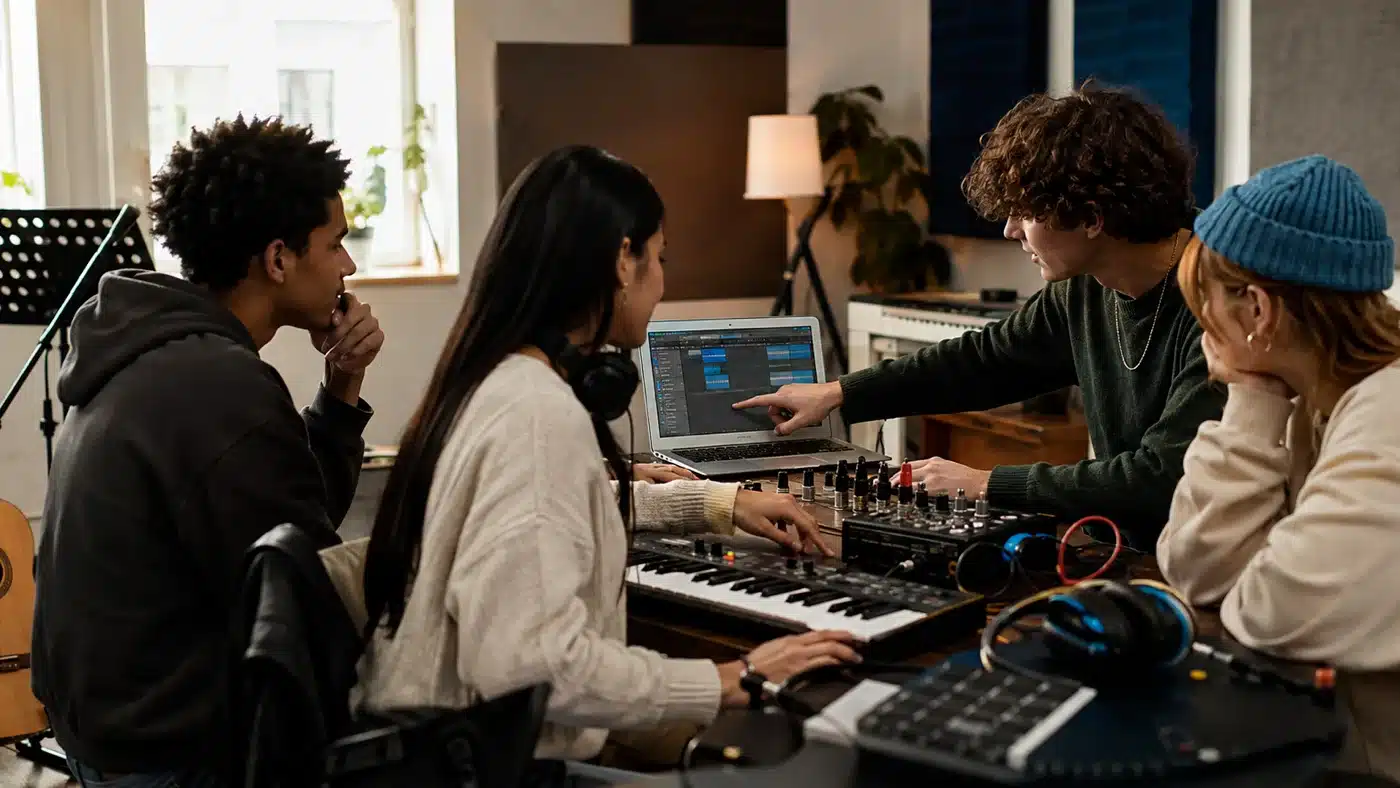
A music lesson can begin with a voice, a violin or a set of piano keys. It can also begin with a laptop, a pair of headphones and the moment a student realises that a sound can be shaped into something of their own.
That second route still appears to be missing from too many classrooms.
New research published by the Night Time Industries Association and Obsurvant on 3 September found a striking gap between school music and the way many people encounter music outside it. In the nationally representative survey, 60% of respondents said their lessons did not reflect the music they listened to, while 51% said they would have been more interested in continuing music if modern production had been taught.
The finding is not an argument against instruments, notation or musical history. It points towards a broader question: what counts as a legitimate beginning?
If a young person first becomes curious through beat-making, sound design, sampling, recording or DJing, education should be able to turn that curiosity into musicianship. The doorway may look different. The creative work behind it is no less real.
The Curriculum Already Leaves the Door Open
England’s national curriculum for music is less restrictive than the debate sometimes suggests. It says pupils should compose, understand how music is produced and communicated, and use technology appropriately. It also asks schools to expose students to a range of genres, styles and traditions.
The problem may therefore be less about whether technology is permitted and more about how confidently and consistently those ambitions are delivered.
A phrase such as “use technology appropriately” can describe anything from recording a performance to building an entire piece inside a digital audio workstation. Without equipment, trained teachers and a clear place for contemporary practice, the more ambitious interpretation is easy to lose.
The government’s 2026 music plan acknowledges that access needs to broaden. It promises a reformed national curriculum from September 2028, exploration of more diverse genres and performance styles, and a review of qualifications that could make alternatives to instrumental performance through technology or voice more viable.
That direction matters. The next step is to make sure production is understood not as an optional technical extra, but as one of the ways people compose now.
Production Is a Form of Musicianship
Modern production asks a student to make musical decisions constantly.
Which sound belongs in the foreground? How should rhythm create tension? When does repetition become hypnotic, and when does it become static? What happens when a texture is filtered, stretched or placed in a different space? How can dynamics, tempo, timbre and structure make an idea communicate?
These are not questions outside music education. They are music education.
A MIDI keyboard does not remove the need to listen. A sequencer does not make arrangement automatic. Software can make certain actions easier, but ease of access is not the same as absence of craft. The student still has to recognise relationships between sounds, develop taste, revise weak ideas and decide when the piece is finished.
Traditional skills can deepen that work. Harmony, rhythm, critical listening, ensemble experience and instrumental technique remain valuable. The strongest curriculum would not force a choice between old and new tools. It would let each illuminate the other.
Relevance Can Be the Beginning of Rigour
There is a reasonable fear that making education more relevant can become a euphemism for making it easier. That does not have to happen.
Starting with music a student recognises is not the same as ending there. A familiar beat can lead into syncopation. A sampled fragment can open a conversation about authorship, copyright and musical memory. A synthesiser patch can introduce acoustics and timbre. Building an arrangement can lead towards form, restraint and the value of silence.
Relevance gives the teacher a point of contact. Rigour determines what happens next.
The survey numbers should also be read with some care. The NTIA describes the research as nationally representative, but its public announcement does not provide a sample size or detailed methodology. The percentages are therefore best treated as a strong signal of disconnection rather than a complete diagnosis of every school.
Even so, the underlying issue is difficult to dismiss. When 60% say the music classroom did not reflect their listening lives, the sector should be curious about what was left outside the door.
Electronic Music Makes the Gap Visible
Electronic music is particularly useful for understanding this problem because its instruments are often processes.
A producer may perform with automation, arrangement, synthesis, editing and spatial design. A DJ learns phrasing, pacing, audience awareness and the relationship between one recording and the next. An ambient musician may create movement through subtle changes in texture rather than through a conventional melody.
These practices do not always resemble the image of musicianship around which school lessons were historically organised. Yet they shape a large part of contemporary music culture.
In Electronic Music Trends in 2026, I explored how today’s electronic landscape moves freely across tempo, genre, geography and listening context. Teaching production can help students understand that landscape from the inside. They learn not only what a sound is called, but how choices create it.
Wallstone projects also illustrate how varied those choices can become. Tempo Syndicate uses BPM and sustained rhythm as part of music’s purpose, while Sleep Passage builds ambient music through restraint, texture and imagined space. Neither route is less compositional because software is involved. The technology is simply where musical judgment becomes audible.
Access Matters as Much as Relevance
Production tools can broaden participation, but they are not automatically equal.
A laptop, headphones, software and monitoring equipment cost money. Students with supportive families or access to community studios can learn through experimentation; others may never get enough time with the tools to discover whether they have an aptitude for them.
Schools can help close that gap. A shared production room may be the first place a student encounters a microphone, a controller or a structured way to turn an idea into a recording. Just as importantly, a teacher can provide something tutorials often cannot: feedback shaped around the student rather than the software.
Government purchasing guidance already recognises digital instruments, recording tools and music-making software as legitimate educational equipment. Hardware alone, however, will not solve the problem. Teachers need time, training and curriculum space to use it meaningfully.
The goal should not be a room full of technology that dates quickly. It should be durable creative literacy: listening, experimenting, collaborating, documenting decisions and understanding the rights and responsibilities attached to recorded work.
Music Careers Are Wider Than the Spotlight
The NTIA survey also found that 54% believed DJing and production should be recognised as legitimate career paths, while 45% felt the curriculum did not prepare young people for careers in today’s music industry.
That discussion should reach beyond becoming an artist.
Contemporary music depends on producers, engineers, live technicians, sound designers, programmers, editors, tour crews, label teams, publishers and many other specialists. A student who enjoys shaping a recording but has no desire to perform may still have found the beginning of a creative career.
Production education can make those roles visible. It shows that music is both expression and infrastructure, and that the person behind the speakers can matter as much as the person in front of them.
A Wider Door Does Not Weaken the Room
Music education does not need to abandon the piano, the orchestra, notation or the canon in order to welcome a sampler, a turntable or a digital workstation.
It needs to resist the idea that one route validates the others.
A student who enters through beat-making may later become fascinated by jazz harmony. Someone who begins on guitar may discover sound design. A singer may learn production to communicate ideas more clearly and gain greater control over recordings. Each new tool can create movement between disciplines rather than a retreat into one of them.
The most important outcome is not that every pupil leaves school ready for the music industry. It is that more of them leave understanding that music is something they are allowed to make.
When education meets young creators where they already are, it does not lower the standard. It gives more people a meaningful chance to reach it.
Sources
- Night Time Industries Association and Obsurvant: modern music production education survey, published 3 September 2026.
- Department for Education: National curriculum in England — music programmes of study.
- Department for Culture, Media and Sport: Turn It Up — Our plan for music, published 13 July 2026.