
For years, the story of physical music has mostly belonged to vinyl.
Records became objects of desire again: large artwork, coloured variants, limited pressings and a ritual that felt deliberately slower than streaming. Compact discs, meanwhile, seemed trapped between eras. Too digital to feel romantic and too physical to feel convenient, they became the format many people assumed would simply fade away.
The latest industry figures suggest that assumption needs revisiting.
On 1 September, the Recording Industry Association of America released its report for the first half of 2026. U.S. recorded-music revenue reached almost $6 billion, rising 6.9% year on year. Streaming remained overwhelmingly dominant, generating $4.9 billion and accounting for 82% of the market.
But the fastest percentage growth came from a much older format. CD revenue rose 58.6% to $171 million. Vinyl revenue also increased, climbing 17.7% to $554 million, while total physical revenue reached $731.5 million.
The CD is not replacing streaming or overtaking vinyl. It is doing something more interesting: becoming relevant again.
The Numbers Need Context
A 58.6% increase creates an irresistible headline, but percentage growth always needs a starting point. CD revenue remains much smaller than streaming revenue and substantially below vinyl. One unusually strong release cycle can also have an outsized effect on a smaller category.
Luminate’s separate midyear analysis helps clarify the trend. It reported that U.S. CD unit sales rose 16% to 16.3 million during the first half of 2026. K-pop collectability was an important driver, but Luminate found that CD sales still grew 6.7% after removing K-pop from the calculation.
Those measures are not identical. RIAA tracks wholesale revenue, while Luminate reports consumer units. Together, however, they point in the same direction. More money is moving through CDs, and more discs are being purchased.
That does not look like a statistical accident. It looks like a format finding a new role.
The CD Sits Between Streaming and Vinyl
Streaming offers access. Vinyl offers ceremony. The CD can occupy the practical space between them.
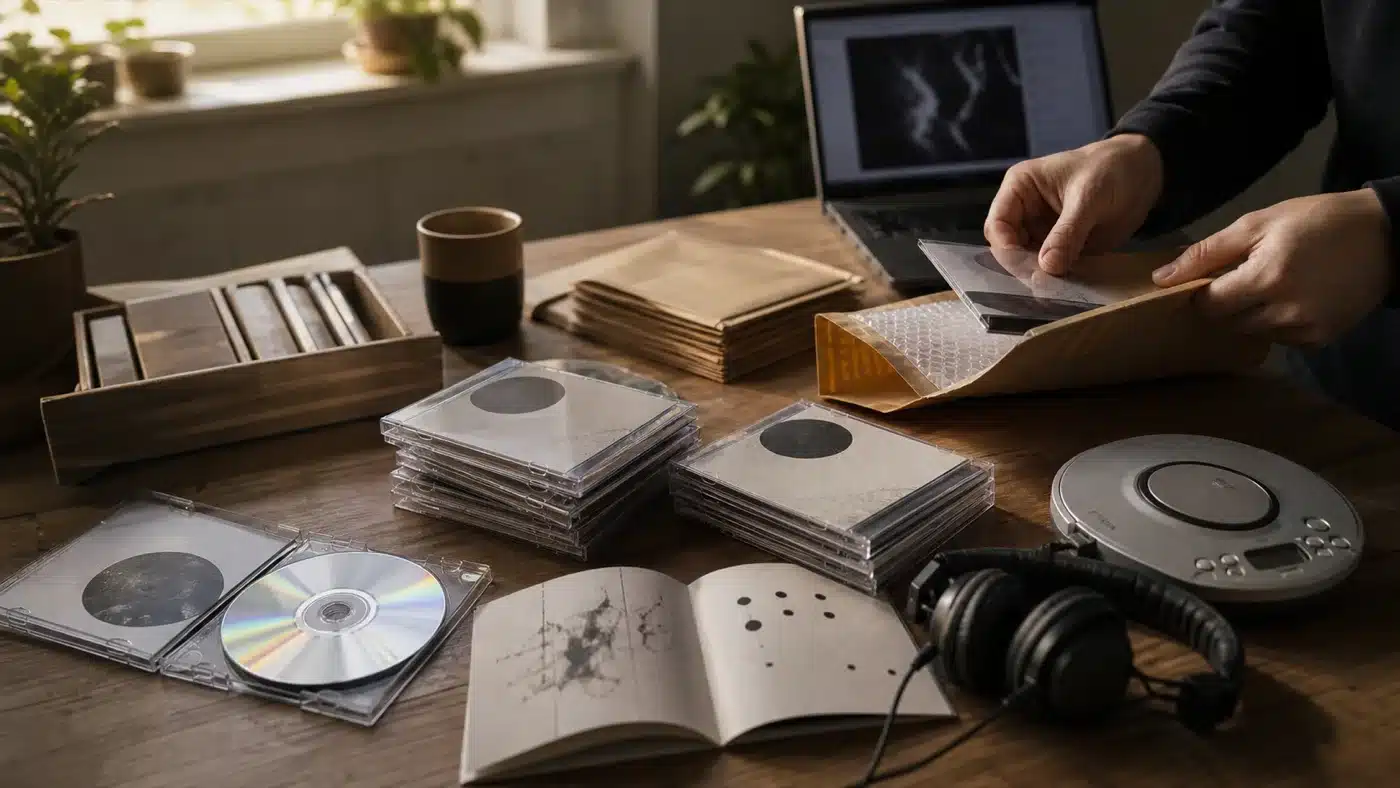
It is compact, durable and familiar. It can carry album artwork, credits, lyrics and sequencing without demanding the manufacturing scale or retail price usually associated with vinyl. A listener receives a real object, while the artist gains room to present the release as more than a square image inside an app.
That middle position matters for independent music.
A fan who is not ready to spend heavily on a deluxe vinyl edition may still want something tangible. A CD can become the affordable object on a merch table, the signed edition sold through an artist’s website or the small-run release mailed directly to listeners who have followed a project from its beginning.
The format does not need to win a competition against vinyl. It only needs to serve a different part of the audience.
Physical Music Turns Support Into an Object
A stream is immediate, measurable and enormously useful for discovery. It is also intangible. The listener presses play, and the experience disappears back into the platform when the song ends.
A physical release remains in the room.
That permanence changes the relationship. Buying a CD can be a small act of patronage as well as a purchase. The fan is not simply accessing the music; they are choosing to keep a version of it.
This connects directly with the growing importance of highly engaged listeners. In The Biggest Audience Isn’t Always the Most Valuable, we explored why a relatively small group of returning listeners can matter more than a much larger group that hears one song and moves on.
Physical music gives those listeners another way to participate. It turns attention into support and support into an object that can carry memory.
Packaging Can Extend the Artist’s World
The most useful physical releases do not treat the disc as a storage device. They treat the entire package as part of the work.
A booklet can contain lyrics, production notes, photographs or fragments of the story behind the recording. The sequencing becomes visible. Credits give names to the people who shaped the sound. Materials, typography and colour can reinforce the atmosphere of the music before the listener presses play.
This is especially relevant for independent artists building a distinctive creative world.
Wallstone Records artist Sleep Passage approaches Meridian Centre as an imagined environment: empty corridors, fluorescent light and the gradual movement from wakefulness toward sleep. A project with that kind of visual and narrative identity already contains the raw material for a meaningful physical edition. The value would not come from placing the same files on a disc. It would come from giving the environment another form.
Not every release needs this treatment. A physical edition should have a reason to exist beyond obligation.
Independent Artists Should Not Confuse Growth With Guaranteed Demand
The return of the CD is an opportunity, not an instruction to manufacture boxes of inventory.
Physical releases introduce costs, storage, fulfilment and the risk of overestimating demand. A format can grow across the market while remaining wrong for a particular artist or audience.
The safest approach is evidence-led. Artists can ask listeners directly, collect pre-orders, begin with a limited run or connect the edition to a specific album, tour or community. The objective is not to appear established by owning stock. It is to make an object that a known group of people genuinely wants.
This is where independent artists can have an advantage. They are often close enough to their audience to recognise repeated names, answer questions and understand which parts of a project generate real attachment.
A small run that reaches the right listeners can be more meaningful than a large pressing designed around an imagined market.
Streaming and Physical Music Are Not Opposites
The RIAA report makes one fact impossible to ignore: streaming remains the centre of recorded music. Physical growth does not reverse that reality.
The stronger strategy is not to choose between digital and physical. It is to let each format do what it does best.
Streaming removes friction. It helps music travel, makes discovery possible and gives listeners immediate access across devices and borders.
Physical music adds concentration. It gives the most committed listeners a deeper version of the release and gives artists a direct transaction that can sit outside the economics of an individual stream.
One format creates reach. The other can create weight.
The CD Did Not Return as the Same Product
The renewed interest in CDs is not simply a rewind to the 1990s. The surrounding music economy has changed too completely.
Today, the disc exists inside a streaming-first world. Listeners may discover an artist through a playlist, follow the story through social media, hear the album digitally and then decide that the music deserves a permanent place in their collection.
That sequence makes the CD less of a default format and more of a deliberate one.
For independent artists, that may be its greatest strength. A CD no longer has to be produced for everyone who might hear the music. It can be made for the listeners who want to hold onto it.
The numbers show that more people are making that choice again.
The opportunity is not to recreate the old record business. It is to use a familiar object to build a more direct, memorable relationship between artists and the people who care most.
Sources
- RIAA 2026 Mid-Year Recorded Music Revenue Report, published 1 September 2026.
- Luminate 2026 Midyear Report, published 15 July 2026.