
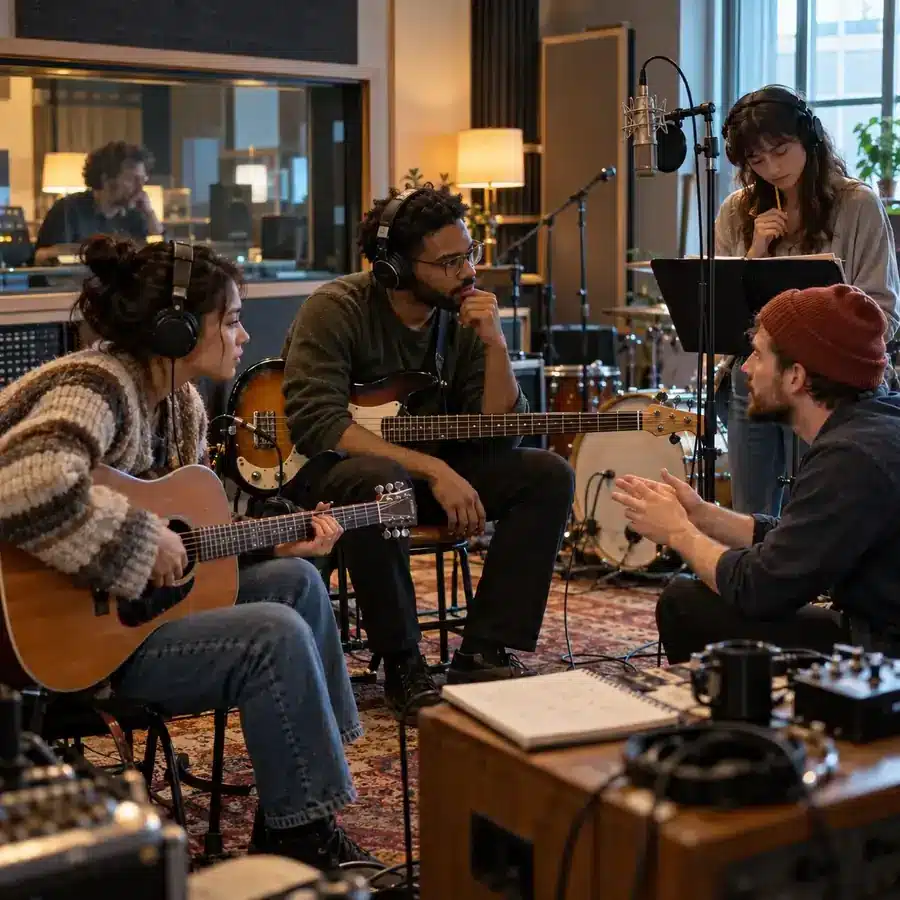
A finished record can make its creation sound inevitable. The voice arrives at the right moment. The bass sits exactly where the song needs it. A small change in rhythm gives the chorus more lift.
Behind those decisions may be musicians, producers and engineers who had to learn how to work together in a room. That craft cannot be developed through theory alone. It needs time, trust and real sessions.
The difficulty for an emerging session musician is that professional work often asks for the very thing a beginner has not yet been allowed to build: professional experience.
A programme in Wales offers a useful response. Forté Project x PPL gives aspiring session musicians and producers practical studio work, mentoring and industry guidance. Just as importantly, it pays them professional session fees.
That last detail changes the meaning of the opportunity. It says that learning and professional respect do not have to begin at different stages.
The First Credit Is the Hardest One to Earn
Session work depends on confidence. An artist needs to know that a musician can understand the brief, arrive prepared and contribute without losing sight of the song. A producer needs someone who can respond quickly when the arrangement changes. The musician needs clear terms and a room where questions are allowed.
Established players can point to credits, recommendations and previous sessions. New players may have the skill but none of that evidence. Without a first opportunity, they cannot build the proof required for the next one.
PPL describes this as a shortage of pathways for people without an existing network or track record. Anastassia Svets of Beacons Cymru also points to a lack of beginner-friendly spaces for session work, production, engineering and collaborative songwriting.
This is not a shortage of ambition. It is an entry-point problem.
A Studio Teaches More Than a Classroom Can
A recording session places musical ability inside a web of practical decisions.
A player may need to simplify a part after one take, change tone without changing instrument or find a new idea while the clock is running. They must listen to the artist, read the producer’s intention and leave space for parts that have not yet been recorded. Sometimes the best contribution is a memorable phrase. Sometimes it is the discipline to play less.
The studio also teaches communication. Musicians learn how to ask what a vague direction means, how to offer an alternative without taking over and how to recover when an idea fails. Producers learn how to explain the emotional purpose of a part rather than hiding behind technical language.
Those skills are difficult to measure in isolation. They become visible through collaboration.
In Why Music Education Needs Modern Music Production, I explored why learning should reflect the way records are actually made. Paid session pathways carry that idea into professional life. They give people a place to practise the working relationships around the music, not only the music itself.
Payment Makes the Opportunity Real
The 2025 Forté programme brought together 20 aspiring session musicians, three producers and three artists. They moved through workshops, rehearsals and studio recordings with experienced professionals. PPL’s account stresses that participants received professional session fees.
That is more than a welcome benefit. It establishes a boundary.
Early-career musicians are frequently told that exposure, a credit or a new contact should be enough. Those things can have value, but they do not cover travel, equipment, rehearsal or the hours spent preparing. When every first step is unpaid, access quietly depends on who can afford to donate their labour.
A paid programme cannot remove every inequality. However, it does not make financial sacrifice a hidden entrance requirement. It also teaches a practical lesson: creative work belongs inside a professional agreement.
The Musicians’ Union’s current agreement with the British Phonographic Industry sets fees and conditions for musicians recording commercial audio releases. For a non-classical session beginning in 2026, it lists £180 for a standard session of up to three hours, with separate provisions for overtime, doubling and overdubbing. The exact agreement will not apply to every project, but its detail shows what professional treatment looks like. Time, scope and additional work should be named rather than left to goodwill.
A Credit Needs a Contract Behind It
Good intentions are not enough when a recording may be released, licensed or reused.
A session agreement should explain the date, duration, repertoire and fee. It should also deal with the rights attached to the recorded performance. The Independent Society of Musicians notes that session players usually receive a one-off fee in return for assigning rights, while featured performers may have a different arrangement that includes royalties.
That distinction matters. A young musician may be grateful to enter the room and reluctant to question a document placed in front of them. A development programme can make contracts part of the learning process, so consent and payment are understood before either becomes urgent.
Credits should also be accurate and usable. A name in the recording information, a clear description of the role and permission to reference the work can help one session lead to another. The opportunity should leave the musician with evidence of what they contributed, not merely a memory that they were present.
Regional Talent Should Not Have to Leave to Become Professional
Forté Project x PPL is delivered by Beacons Cymru and focuses on building careers in Wales. The 2026 edition selected 18 session musicians and three producers through an open process. Rehearsals and arrangements took place in June and July, recording followed in August, and the final tracks moved into mixing and mastering during September and October.
That sequence is valuable because it resembles a real production rather than a single demonstration day. Participants can see how an arrangement travels from rehearsal to recording and then changes again during the final production stages.
It also keeps professional development connected to place. Emerging musicians should not have to move to the largest industry centre before anyone treats their work seriously. Regional programmes can create local relationships between artists, players, producers and engineers. Those relationships may then support future records, live projects and paid work long after the programme ends.
PPL Giving says its support is guided partly by equity and geographic diversity. That principle matters because talent is widely distributed while access is not.
Artists Need This Infrastructure Too
The case for paid session pathways is not only about the people playing the parts. Artists benefit when more musicians understand how to serve a recording with confidence and imagination.
An independent artist may need a drummer for one song, a string player for a small arrangement or a producer who can translate a live idea into a finished track. A strong local network makes those collaborations easier to begin. It also gives artists more choices than doing everything alone or hiring from a distant circle they cannot easily enter.
That does not mean every recording needs a large team. Many excellent records are made by one person. The point is that self-sufficiency should be a creative choice, not the result of an industry that failed to develop collaborative talent.
When emerging players gain real credits and artists meet new collaborators, the value moves in both directions. The session becomes part of a larger creative ecosystem.
What a Useful Entry Programme Should Provide
Forté offers a model worth examining beyond Wales. A serious pathway into session work should include several connected elements.
- An open route in. Selection should not depend only on private recommendations from people already inside the profession.
- A real musical brief. Participants need to work towards recordings with an artist and a purpose, not complete exercises that disappear when the workshop ends.
- Time to rehearse. Studio confidence begins before the record button is pressed.
- Professional fees and written terms. The programme should model the standards it wants participants to carry into future work.
- Useful credits and feedback. Musicians need evidence of their contribution and honest guidance about what will help them get rebooked.
- Relationships that can continue. Mentoring is strongest when it creates a route into a wider working community.
None of these elements guarantees a career. Together, they make the first professional step less dependent on luck, family resources or an informal introduction.
The Industry Has to Fund the Beginning
Music depends on people whose names may never appear on the front cover. Their timing, judgement and ability to listen can change what a song becomes.
If the industry wants skilled session musicians, producers and engineers, it cannot wait for them to arrive fully formed. Someone has to provide the first room, the first clear agreement and the first credit that another employer can trust.
Forté Project x PPL is relatively small. Its importance lies in the standard it sets. Participants are not asked to choose between being learners and being professionals. They receive guidance while their work is treated as work.
A sustainable music career rarely begins with one dramatic breakthrough. Sometimes it begins with three paid hours in a studio, a part that serves the song and a producer who wants to call again.
Frequently Asked Questions
What does a session musician do?
A session musician is hired to perform on a recording or live production without necessarily joining the artist’s permanent group. The work can involve reading an arranged part, improvising, developing a sound with the producer or adapting an existing song for a particular recording.
Should an emerging session musician work for free?
A musician may choose an informal collaboration for creative reasons, but professional session work should have clear terms and fair payment. Paid entry programmes are valuable because they provide experience without making unpaid labour the price of access.
What should a recording-session agreement include?
At minimum, it should identify the parties, date, location, duration, repertoire, fee and payment terms. It should also explain how the recorded performance may be used and which rights or consents are being granted. Musicians should seek qualified advice when the terms are unclear.
Sources
- PPL: Breaking into session work—how Forté Project x PPL is creating opportunities for emerging Welsh musicians, 22 October 2026.
- PPL Giving: funding principles and music-development support.
- Musicians’ Union: BPI agreement, recording-session rates and consent forms, updated 28 January 2026.
- Independent Society of Musicians: recording-session contract guidance.