
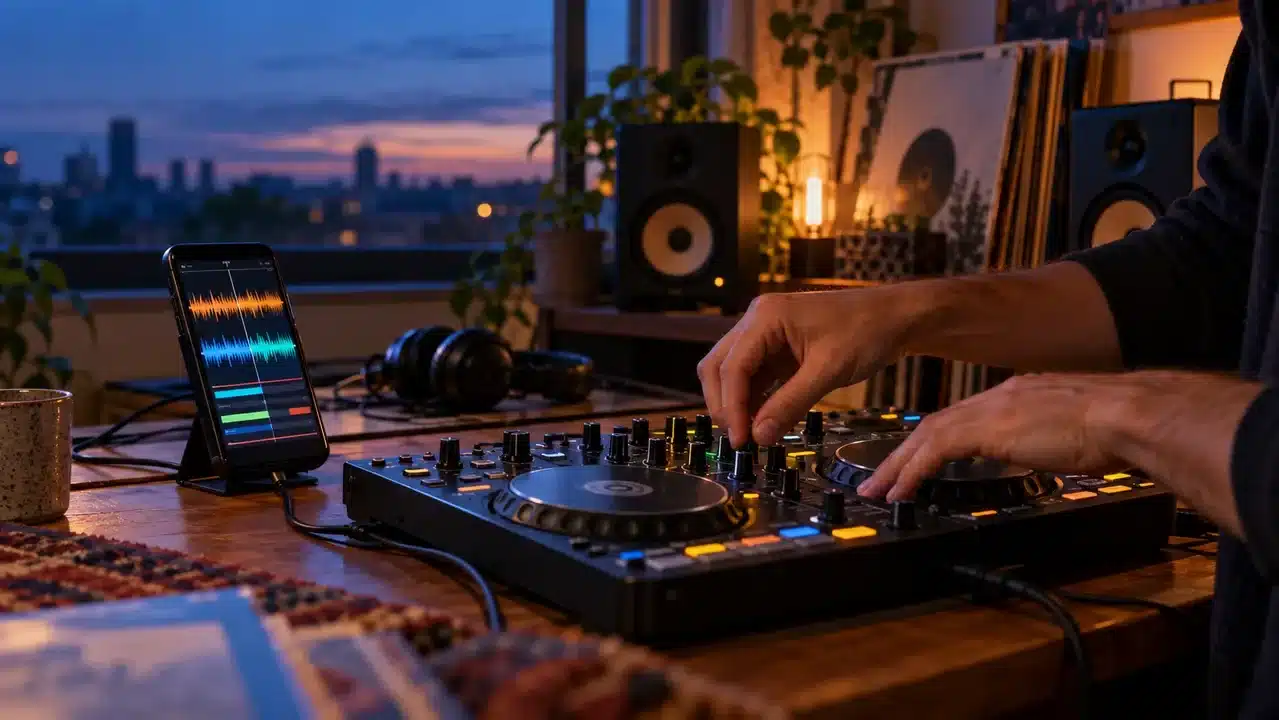
A phone is starting to look less like a backup DJ tool and more like a place where a set can begin.
Apple Music has expanded its presence inside DJ software. Its current partner hub includes Serato, edjing Mix and VirtualDJ. Serato has also launched a dedicated app for iPhone and iPad, while edjing Mix now lets Apple Music subscribers work with their libraries on those devices. VirtualDJ added Apple Music to its desktop software in an October update.
The important change is not that a phone can imitate a pair of decks. Mobile DJ apps have done that for years. What feels different is the way listening, discovery and preparation are moving into the same space.
A track can travel from a saved playlist to a practice mix without the listener rebuilding the idea in another library. That shorter path could change how more people learn to select music, test transitions and understand why two records belong together.
The Practice Room Is Becoming Portable
Serato DJ for iOS includes decks, crates, waveforms, cue points, effects and beatgrids. It can run on the screen alone or connect to more than 120 supported hardware setups. Existing Serato users can also move crates and preparation data from a computer to an iPhone or iPad.
That makes the mobile device useful before it ever reaches a venue. A DJ can sketch a sequence on a train, test a difficult transition at home or bring prepared crates to a smaller setup without carrying a laptop.
Portability matters most when it creates more time with the music. The person who can practise for twenty minutes in an ordinary gap may learn more than the person who waits for a perfect room and a free evening.
It also lowers the cost of curiosity. A beginner can explore the shape of a set before buying a full collection of hardware. That does not make professional equipment irrelevant. It gives someone a clearer reason to invest because they have already started learning what they need.
Discovery Can Become a Decision
Streaming usually presents music as a sequence of listening choices. DJ software asks a different question: what should happen next?
Once a saved song appears beside decks, waveforms and tempo information, passive discovery becomes an active decision. The listener begins to hear the opening bars, the breakdown and the ending as material. A favourite track may prove difficult to place. A less obvious one may suddenly reveal the exact tension a set needs.
Apple Music’s DJ hub now places platform partners beside playlists from labels and dance-music brands. That arrangement connects discovery with use. A listener can find a sound through a curated playlist, then explore how it behaves in a mix.
This is valuable because recommendation systems can find similarity, but they cannot decide what a particular room needs. Selection still belongs to the person building the arc.
Access Is Not the Same as Ownership
The convenience has clear limits.
Serato says Apple Music streaming requires an active subscription and internet connection. It does not allow recording when streamed tracks are loaded, and its stems tools are unavailable for those tracks. Edjing Mix also describes Apple Music as online-only and for personal, non-commercial use. Local, unprotected files offer a wider set of options inside the app.
Those distinctions matter. A streaming catalogue can be excellent for exploration and practice, but it is not a permanent record bag. Availability can change. A weak connection can interrupt access. App and service rules can also determine which creative tools work.
DJs therefore need to understand the source of every track they load. A subscription library, a purchased download, a promotional file and an original production do not create the same practical or legal relationship with the music.
The easiest library to open should not become the only library a DJ knows how to manage.
A Smaller Screen Creates Different Risks
Mobile performance removes one object from the setup, but it also concentrates more responsibility in a device built for many other tasks.
A phone carries calls, messages, battery limits and system notifications. Serato advises performers to use Focus Mode or Do Not Disturb because incoming communication can interrupt a set. Cables and adapters still need testing. A bright screen in a quiet room is different from a small display under venue lighting.
That does not make mobile DJing unserious. It means reliability has to be rehearsed alongside the music.
A useful preparation routine should include the exact device, connection, controller and audio path that will be used. The DJ should know what happens if the network disappears, where a local backup lives and how the set continues when the convenient option fails.
Independent Artists Gain a Shorter Route Into the Mix
For independent electronic artists, the most interesting part is not the size of the streaming catalogue. It is the reduced distance between being heard and being tried.
A listener may save a track during the week and test it in a practice set the same evening. The track does not need to be downloaded again or found inside a specialist store before that first experiment begins.
That does not guarantee club play. It does, however, remove one small point of friction.
For an electronic project such as Tempo Syndicate, that shorter route is meaningful. Music made around momentum and physical movement can now enter a listener’s practice space almost as quickly as it enters a playlist. The artistic challenge remains the same: the track still has to earn its place beside other records.
Artists and labels can help by keeping titles, versions, credits and artwork clear across services. A DJ needs to know whether a track is an original, an edit, a radio version or an extended mix. Good metadata will not make a record compelling, but poor metadata can make a useful record harder to trust.
The Set Is Still More Than the Software
In When the DJ Set Becomes Part of the Catalogue, I wrote about how recorded sets can preserve context that individual tracks lose. Mobile tools begin earlier in that process. They give more people a place to discover the context by building it themselves.
Yet an enormous library can make selection harder. When almost every song is available, the value shifts towards restraint. The DJ has to reject good tracks, remember unexpected connections and understand when familiarity helps a room rather than flattening it.
Software can analyse tempo and align beats. It can move cue points between devices and place millions of songs within reach. It cannot decide why one record should follow another at a particular moment.
That judgement develops through listening, repetition and attention to people.
The Booth Is Expanding, Not Disappearing
Mobile DJing will not replace every laptop, controller, turntable or carefully organised local library. It does not need to.
Its strongest use may be less dramatic. It turns more places into practice rooms. It lets an idea survive the distance between hearing a track and trying it. It gives a beginner an accessible way to learn that DJing is not simply playing two songs at once.
The phone makes the tools portable. The craft still comes from knowing the music well enough to create a reason for the next track to arrive.
Frequently Asked Questions
Can you DJ with Apple Music on an iPhone?
Yes. Apple Music is available inside supported iPhone and iPad apps including Serato DJ for iOS and edjing Mix. An active Apple Music subscription and internet connection are required.
Can Apple Music tracks be used offline or recorded in a DJ mix?
The current integrations have restrictions. Serato requires an internet connection for Apple Music and does not allow recording or stems with streamed tracks. Edjing Mix also lists Apple Music as online-only and for personal, non-commercial use. DJs should check the latest rules for the specific app and service before a performance.
Sources
- Apple Music: DJ with Apple Music partner hub.
- Serato: Introducing Serato DJ for iOS, 20 October 2026.
- Serato: DJ for iOS features and compatibility.
- Serato Support: Apple Music streaming FAQ.
- Edjing Mix: supported music sources and Apple Music limitations.
- VirtualDJ: build 9729 changelog, 22 October 2026.