
Some songs begin on the road. Static and Gravel begins in the room before the door opens.
Highway Lantern releases its fourth single, “Static and Gravel,” today, 30 October 2026. The track turns domestic frustration into forward motion, carrying a restless narrator from a buzzing kitchen light towards a waiting car and an uncertain night.
Listen to Static and Gravel: Spotify · Apple Music · Amazon Music · YouTube Music
Fuzz-heavy guitars and a driving rhythm give the single its physical pull. Yet the song’s real tension lies in the moment before movement, when staying has become unbearable but leaving has not become an answer.
The Road Starts Inside the House
The opening lyric stays close to familiar objects: a kitchen light, four walls, an old radio and keys already held in the narrator’s hand.
Nothing dramatic has happened on the surface. That makes the unease more convincing. The body has recognised the need to leave before the mind can explain it.
Highway Lantern often uses open roads, empty spaces and weathered landscapes to create distance. Here, the journey starts in a cramped interior. Conversation has turned into noise. Time feels slow. Even the ordinary tick of a clock becomes another reason to move.
The keys matter because they reveal that the decision is already underway. The narrator keeps checking for them, as though movement has become instinct rather than a plan.
Static Is the Feeling That Cannot Be Named
The title joins two kinds of interference.
Static is emotional. It fills the space where words should be and makes another person difficult to hear. The narrator cannot offer a clean explanation because the pressure has not yet formed into one.
Gravel is physical. It sits beneath the feet and tyres, turning the urge to escape into a sound that can be followed.
Together, those images give the chorus its central rhythm. The song does not solve the restlessness. Instead, it finds a temporary pattern inside it. Static becomes the noise pushing from behind, while gravel becomes proof that the car is finally moving.
That distinction keeps the track from becoming a simple road anthem. The journey promises relief, but not certainty.
Leaving Is Not Presented as Victory
The narrator insists that the departure is not an attack on the person left behind or the town itself. Even so, the explanation remains incomplete.
That uncertainty gives the song emotional weight. There is no villain in the room and no destination waiting at the other end of the drive. There is only a feeling that has been building behind a closed door.
The line about one more mile healing something “for a while” is especially important. Highway Lantern does not present motion as a permanent cure. The road offers space, time and a different rhythm, but the song understands that distance cannot settle every question.
By the bridge, restlessness begins to look less like a passing mood and more like part of the narrator’s nature. The possibility is both freeing and painful: perhaps some hearts do not know how to remain still, even inside something peaceful.
A Rougher Chapter for Highway Lantern
Static and Gravel follows Engine and the Wheel, Ghost Town Radio and Dust Never Sleeps. Each release has found a different emotional use for the road.
Engine and the Wheel established movement. Ghost Town Radio listened for voices in abandoned places. Dust Never Sleeps slowed down long enough to face memory and what remains after loss.
The new single puts the wheels back in motion, but it does not return to the beginning. This time, the road carries the accumulated weight of those earlier songs. Movement feels necessary because stillness has become too loud.
Earlier this month, I introduced Static and Gravel before its release as a song about tension and an uncertain road. The completed lyric makes that tension more personal. The landscape is not merely somewhere the narrator travels through. It is the only place where thought, noise and motion briefly fall into the same rhythm.
The Artwork Holds the Same Distance
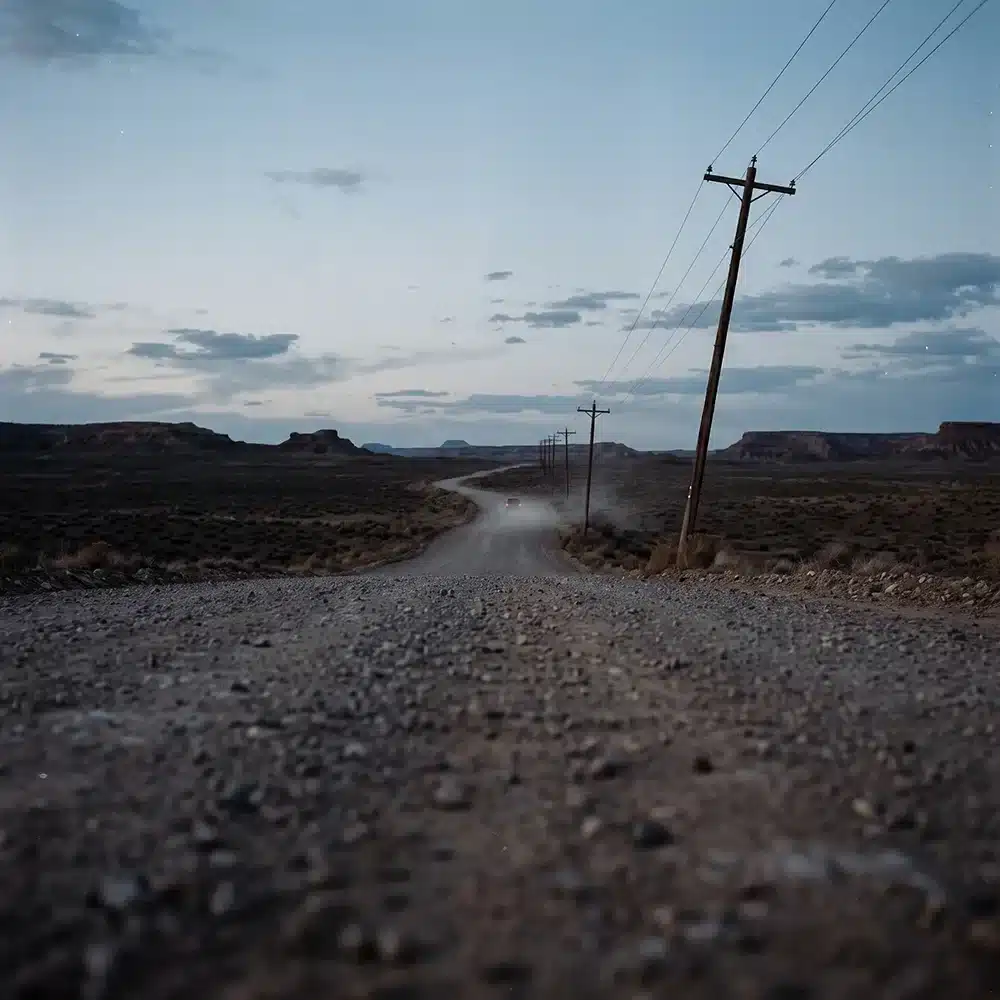
The single’s visual world keeps the scale wide. A gravel road cuts through a desert landscape beneath a line of telephone poles. Far ahead, a lone car lifts dust into the air.
That distance mirrors the lyric. The driver has left, but the destination remains invisible. Telephone lines suggest connection while the empty road makes isolation impossible to ignore.
Nothing in the image promises arrival. Like the song, it concentrates on the act of moving away.
Explore Highway Lantern at Wallstone Records
About Highway Lantern
Highway Lantern creates cinematic desert rock shaped by fuzz guitars, driving rhythms and stories from the open road. The project’s songs move through ghost towns, distant radio signals, memory and the pull of the horizon.
Highway Lantern is part of the Wallstone Records artist roster.