
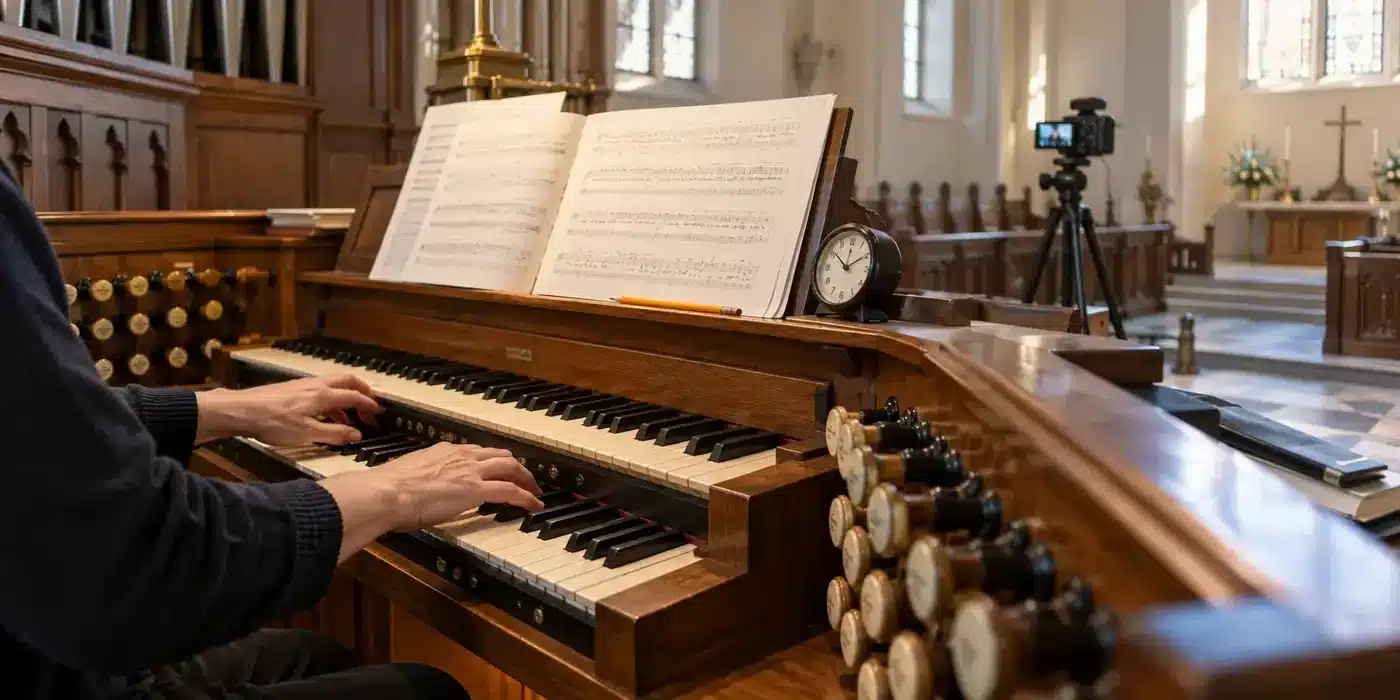
A musician can be paid for ninety minutes and still give half a day to the job.
The performance is the visible part. Before it comes the repertoire, rehearsal, emails, travel, equipment, administration and the quiet responsibility of making sure the music is ready when the room needs it.
New guidance from the Musicians’ Union makes that hidden work unusually clear. Its redesigned rates for organists and ceremonial musicians introduce separate categories for different levels of responsibility, new rehearsal fees, an hourly preparation rate and updated terms for recording and livestreaming.
The details concern a specific part of the profession. The principle reaches much further: a fair fee should reflect the complete job, not only the minutes when someone can hear the instrument.
One Performance Can Contain Several Jobs
Organ playing can look like a single task. The new structure shows why it is not.
For a regular service lasting up to ninety minutes, the MU recommends a minimum of £89.46 for playing without choral or vocal accompaniment. The figure rises to £107.35 when the musician accompanies singers and to £128.81 when the organist is also responsible for directing the choir.
Those are not three prices for the same work. They describe three different roles. Accompanying requires musical coordination. Directing adds leadership, decisions and accountability. A fee becomes clearer when the responsibility becomes visible.
The distinction matters across music. A guitarist hired to play written parts is doing a different job from one expected to arrange them. A producer running a session may also be editing, coaching a performance and managing files. A band member asked to organise rehearsals, transport equipment and advance a show is carrying work that does not appear in the set length.
When every task hides inside one vague fee, the person who works most carefully can end up donating the most time.
Preparation Is Work Before It Becomes Music
The most important addition may be the preparation rate.
The MU now recommends £59.64 per hour for duties connected to an engagement. Its examples include learning repertoire, becoming familiar with a new instrument, attending meetings, handling emails and completing general administration. Specialist arranging, orchestration and transcription sit outside that rate and require their own terms.
This is a useful boundary. Preparation is not an abstract quality that professionals should provide without limit. It consists of hours and tasks.
A musician may receive a late programme change, work through a difficult transition or answer a chain of practical questions before anyone arrives. None of that is audible as a separate item. It is audible as confidence.
The better the preparation, the easier it is to forget that it happened.
Rehearsal Cannot Be Folded Into Goodwill
The redesigned framework also separates rehearsals from the service itself.
A same-day rehearsal of up to ninety minutes has its own recommended minimum, ranging from £75.19 to £108.27 depending on the organist’s responsibilities. A rehearsal held on another day attracts the full agreed service fee, plus applicable travel and porterage.
That distinction recognises what a calendar already knows. Returning on another day is another engagement. It may require a second journey, another equipment plan and time that cannot be offered elsewhere.
Independent projects often blur this boundary. Someone says the rehearsal will be quick, the edit will be small or the meeting will only take a moment. Individually, those requests sound harmless. Together, they can consume the margin that made the job viable.
Clear terms do not make collaboration cold. They stop generosity from becoming the business model.
Recording Changes the Assignment
A performance in a room ends when the room empties. A recording can continue to be watched, shared and reused.
The MU guidance says permission should be obtained before recording an organist. For a private video of a wedding or another special service, it recommends an additional £107 fee. Livestreaming fees sit on top of the performance fee and change according to how long the stream remains available, from a 24-hour window to six months.
The numbers are specific to this agreement, but the separation is important. Performance and recording are not identical uses. A camera changes the value and lifespan of the work.
Musicians should know whether a recording is private, promotional, monetised or permanently available. They should also know who may edit it, where it can appear and how long permission lasts. “We might film something” is not a complete term.
A Minimum Is a Starting Point
The MU describes these figures as recommended minimums. It also notes that higher fees may be appropriate because of the location, venue, responsibility or nature of the engagement.
That matters because a rate card cannot price every situation. It creates a floor and a vocabulary for negotiation.
A musician can point to preparation, separate-day rehearsals, travel, equipment, overtime and recording rights instead of trying to defend one unexplained total. The engager can see what is included and decide what the project actually needs.
The result should be a better agreement, not a longer invoice for its own sake.
Independent Artists Are Engagers Too
Fair-rate guidance is not only for musicians negotiating with large institutions. Independent artists and small labels hire people as well.
A modest recording may involve a session player, engineer, photographer or designer. A live show may require additional musicians, a sound engineer or someone to manage playback. Limited budgets do not remove the need for clear scope. They make it more important.
If the full fee is unaffordable, the honest response is to reduce the assignment, change the arrangement or delay the work. It is not to leave essential preparation outside the conversation and hope the collaborator absorbs it.
In A Music Career Needs a First Paid Session, I wrote about why entry routes should not make unpaid labour the price of experience. The same principle applies after that first credit. A sustainable career depends on learning to describe the whole job and ask whether the terms support it.
The Quote Should Explain the Work
A useful quote does more than name a total. It explains what the total buys.
- What performance or deliverable is included?
- How much rehearsal and preparation is expected?
- Are travel, equipment and additional responsibilities covered?
- What happens when the schedule changes or the work runs over?
- Can the performance be recorded, streamed, edited or reused?
- When and how will payment be made?
These questions protect both sides. They turn assumptions into decisions before the work begins.
The Invisible Hours Keep Music Professional
The redesigned organist rates are valuable because they look beyond the moment of performance. They recognise that responsibility has levels, preparation has a duration and recording creates another use.
That is not bureaucracy placed around music. It is a way of respecting the labour that lets music feel effortless when it finally reaches the room.
A fair fee cannot measure every act of care. It can at least stop pretending that care takes no time.
Sources
- Musicians’ Union: MU Redesigns Organists and Ceremonies Rates, published 30 October 2026.
- Musicians’ Union: Organists and Ceremonies Rates, updated 30 October 2026.
- Musicians’ Union: Recommended Minimum Rates for Live Musicians.