
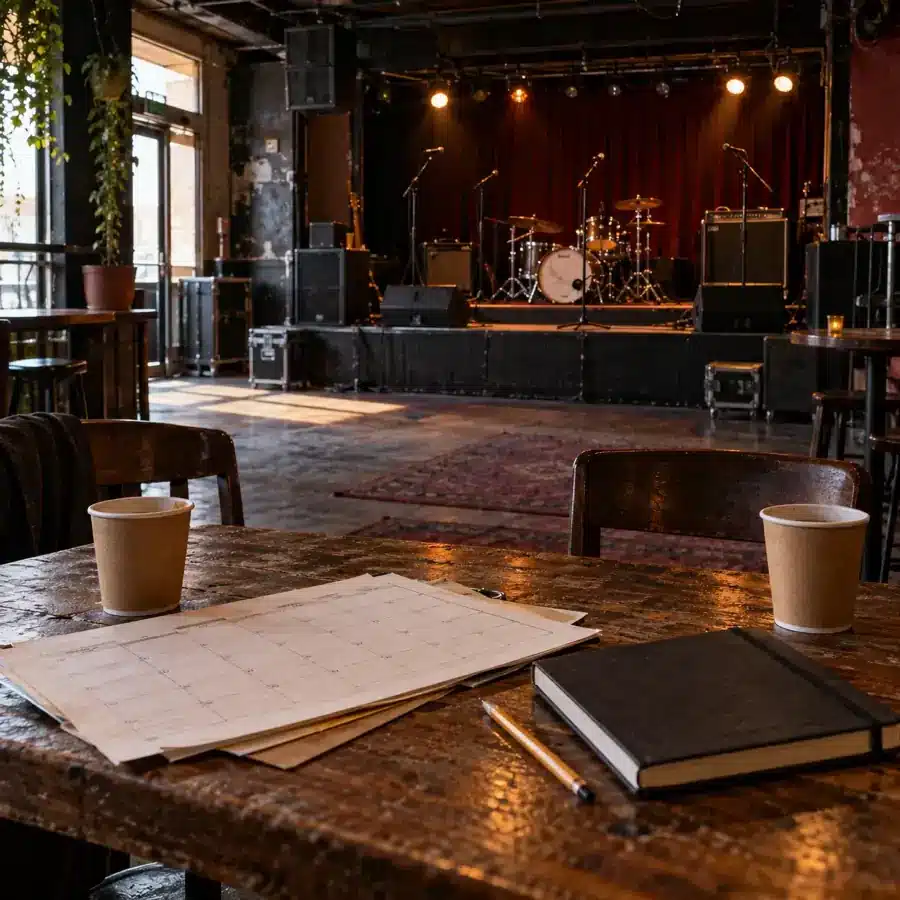
A gig begins long before the artist walks onstage.
Someone trusts the act enough to offer a date. Someone else works out the room, the ticket price, the guarantee and the risk. A promoter decides how to reach an audience. An agent tries to place one night inside a route that makes sense. Grassroots live music booking depends on all of them seeing the same possibility at roughly the same time.
That hidden work came into focus on 13 October, when Music Venue Trust, the Association of Independent Festivals, the Association of Independent Promoters and the Entertainment Agents’ Association held their second Grassroots Networking Day at 229 London. The event brought 300 agents, promoters, festival programmers and venue bookers together to build relationships and create better shows.
The idea sounds simple: put the people who make live music happen in one room. Yet the programme reveals how complicated that work has become.
A Show Is a Chain of Agreements
The day included meetings between independent agents and bookers, workshops on fair show offers, sessions about tour gaps and discussions about reaching new audiences. One panel followed a long-term relationship formed around a single artist. It asked how venues, promoters, festivals and agents share risk and reward.
This is the machinery behind a date on a tour poster.
Fans see the final result: an artist, a room and an evening that either catches fire or falls flat. Before that can happen, several small organisations must agree on a workable version of the night. Each carries a different risk. The venue has staff and overheads. The promoter has marketing costs and ticket uncertainty. The agent must protect the artist’s value while helping to build a route. The artist needs the performance to justify the time, travel and preparation.
A weak agreement can pass pressure down the chain until the musician absorbs it. A strong one does not remove risk, but it makes the risk visible and gives each partner a reason to help the show succeed.
Relationships Are Part of the Infrastructure
Networking often gets presented as a personality test. Be confident, collect contacts and keep introducing yourself. That advice misses the point.
In live music, a useful professional relationship reduces uncertainty. A venue booker remembers that a promoter communicates clearly. An agent knows which room treats emerging artists well. A festival programmer learns who can deliver an unusual act to the right audience. Trust turns incomplete information into a decision.
That matters most at grassroots level, where nobody has enough money to solve every mistake. A reliable introduction can be worth more than a large contact list. It can also open a route for an artist who has not yet generated the streaming numbers or press attention that make a booking feel obvious.
Grassroots Networking Day formalised that process through short discovery sessions and pre-booked one-to-one meetings. Participants were not simply invited to mingle. The schedule created practical opportunities to compare needs, discuss offers and find partners.
The Fair Offer Comes Before the Sold-Out Room
One workshop used a fictional 200-capacity show to examine guarantees, splits, venue costs, production, marketing, ticket fees and break-even. That is not glamorous work. It is also where the health of a show can often be decided.
A fair offer is not always the largest number. It is an offer built from assumptions that both sides understand. How many tickets must sell? Which costs come off before a split? Who pays for production? What happens if sales are slow? Which party controls the marketing budget and the audience data?
Clear answers let people make an informed choice. Vague answers create resentment after the money has already gone.
The same realism applies to touring. A date that looks attractive on its own may become impossible once travel, accommodation, equipment and rehearsal enter the calculation. Help Musicians recently described those upfront costs as a reason musicians turn down career-building opportunities. Its Fast Track Live programme combines grants of £500 to £1,000 with specialist advice, aiming to help artists convert a promising performance into longer-term progress.
The important word is convert. Playing more shows is not automatically artist development. The show needs a purpose: reach a new city, deepen an audience, test a set, meet future partners or create momentum for the next booking.
Better Networks Can Widen the Stage
Access to live opportunity is uneven. Help Musicians cites its Musicians’ Census finding that 80% of musicians reported at least one career-restricting barrier. When the cost of accepting a show becomes too high, the available stage no longer reflects the full range of talent.
Money is one barrier. Professional access is another. Artists who already know agents, promoters and bookers can move through the system more easily. Others may have strong music and no clear path to the people who can place it in a room.
Industry networking will not fix that inequality by itself. However, it can make the route less dependent on chance if the right people attend, the meetings have a clear purpose and new relationships lead to real offers.
That is why travel bursaries and structured meetings matter. They recognise that an open invitation is not the same as equal access. The sector has to design the connection, not merely announce that the door is open.
Local Rooms Need Long Memories
A grassroots venue is more than the setting for an early show. It is where artists discover how their music changes in a room, and where audiences can form a connection with something they have never heard before. For agents and promoters, those nights reveal qualities that streaming figures and online dashboards cannot measure.
In The Best Music Awards Leave Something Behind, I wrote about the value of investing in the rooms, crews and artist-development routes that remain after a cultural event ends. Booking relationships belong to that same local infrastructure. They carry knowledge from one night to the next.
A booker remembers the artist who grew into the room. A promoter remembers the audience that arrived for an unexpected pairing. An agent remembers who handled a difficult night fairly. Over time, those memories influence which risks people will take together.
This is slower than chasing one viral moment. It is also how a live circuit becomes a culture rather than a string of isolated transactions.
The First Gig Starts With a Better Conversation
The most revealing thing about Grassroots Networking Day is not that the industry needs more events. It is that live music needs places where practical trust can form.
Artists are often told to perform more, build an audience and create momentum. Behind each instruction sits a network of people negotiating money, geography, timing and belief. If that network becomes stronger, a good act has more chances to meet the right room. If it weakens, even worthwhile music can remain stranded between a recording and an audience.
No meeting can guarantee a great show. Still, a clear offer, a workable route and a trusted partner can make the show possible.
The first note belongs to the artist. The first step towards hearing it live may begin with two people deciding they can build something together.
Sources
- Music Venue Trust: Grassroots Networking Day 2026 programme, 13 October 2026.
- Music Venue Trust: Grassroots Networking Day returns for a second edition, published 26 August 2026.
- Help Musicians: Fast Track Live, published 7 September 2026.