
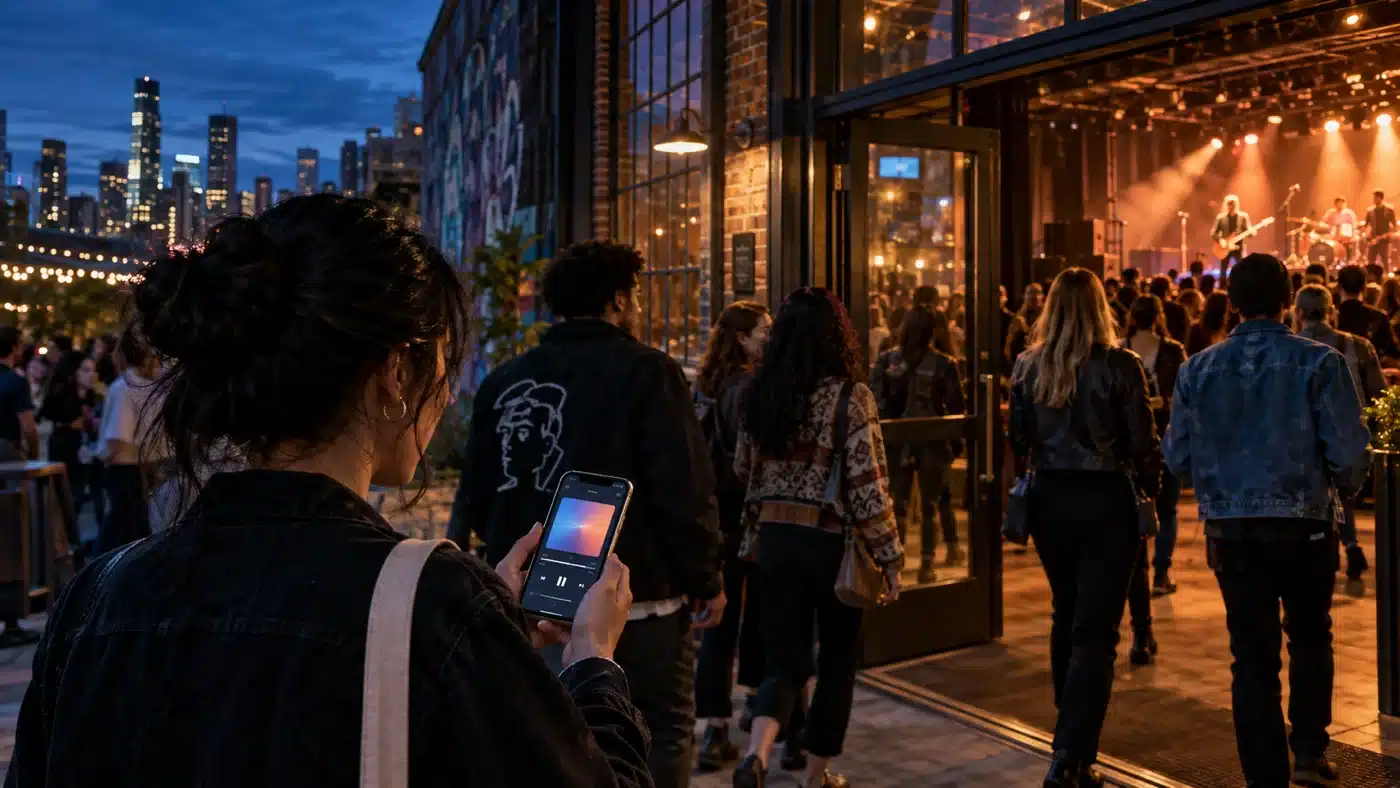
A playlist usually feels weightless. It exists behind glass, updates without ceremony and follows the listener wherever they go. On 8 September, Spotify announced an experiment in giving one of those playlists a door, a stage and a room full of people.
RNB X Live will take place on 1 November at The Pavilion at Toyota Music Factory in the Dallas area. Created with Live Nation, it is Spotify’s first standalone R&B concert and the largest physical expression so far of RNB X, the platform’s editorial R&B playlist.
The lineup brings together Erykah Badu, H.E.R., kwn, DESTIN CONRAD, Jai’Len Josey and rjtheweirdo. Established artists share the bill with newer voices; Dallas artists appear at both ends of the programme; and select performances will later return to the platform through Spotify Live.
The announcement is more than another branded concert. It points towards a wider change in music discovery: playlists are beginning to behave like cultural institutions, moving beyond the screen to create live experiences, communities and identities of their own.
A Playlist Is Already a Kind of Place
A strong editorial playlist does more than collect songs. It establishes a mood, defines a musical neighbourhood and teaches listeners what belongs beside what.
Over time, the name and visual identity of the playlist can become familiar even when the individual tracks keep changing. Listeners return because they trust the selection. Artists want to appear there because that trust can transfer, briefly, to an unfamiliar song.
RNB X has served that role inside Spotify for years. The Dallas event makes the metaphor physical. The artists who have shared a digital sequence now share a stage, while listeners who encountered the playlist privately can experience its identity together.
That shift matters because streaming discovery is efficient but often solitary. A recommendation can introduce a song in seconds, yet the listener may never see who else responds to it, understand the scene around it or remember the artist after the next track begins. A concert replaces that invisible audience with a visible one.
Discovery Becomes More Memorable When It Is Experienced
The RNB X Live lineup is built around contrast and continuity. Erykah Badu and H.E.R. provide recognition, while kwn, DESTIN CONRAD, Jai’Len Josey and rjtheweirdo represent newer parts of contemporary R&B. Spotify says several of those emerging artists have previously appeared in programmes such as Fresh Finds and Artists To Watch.
This creates a familiar festival dynamic: established names attract attention, but the surrounding context gives audiences a reason to encounter artists they might not yet know.
On a playlist, that encounter may last for the first few seconds of a track. In a venue, it becomes harder to reduce an artist to a thumbnail and a skip button. The audience sees how a song inhabits a room, how the performer speaks between tracks and how other listeners respond.
I wrote recently about why earning attention has become one of the hardest parts of making music. A live playlist event cannot solve that problem at scale, but it can make a smaller number of discoveries mean more. It turns selection into an occasion.
For emerging artists, that depth may be more valuable than another moment of anonymous reach. A listener who remembers a performance has a reason to search for the artist again after the event.
From Listener Data to a Real Audience
Spotify is using access to the event to connect digital listening with physical attendance. Premium listeners identified as top fans receive a presale opportunity before general tickets go on sale.
That bridge is significant. Streaming services know which listeners repeatedly return to a genre, playlist or artist. Live events give them a way to turn those behavioural signals into invitations—and to see whether digital affinity translates into the willingness to show up.
For fans, this can feel relevant rather than random. For artists and promoters, it offers the possibility of reaching people whose listening already suggests genuine interest. For the platform, it creates a relationship that extends beyond time spent in the app.
The concert is also designed to travel back in the other direction. Spotify says selected performances will be captured for release through Spotify Live, allowing a local event to become platform content for listeners elsewhere. The result is a loop: a playlist builds an audience, the audience gathers in person, and the live experience returns to the service as something new to discover.
The Playlist Brand Is Becoming More Powerful
There is an obvious benefit to giving music discovery a physical dimension, but the development also deserves scrutiny.
When a streaming platform turns a playlist into an event, it is no longer only distributing or recommending music. It is acting as editor, brand owner, audience analyst, ticketing partner, promoter and media outlet around the same cultural space.
That concentration can create meaningful opportunities. It can also make the boundaries around selection more consequential. Which artists are placed on the playlist? Which are invited onto the stage? Whose performance is captured and redistributed? How clearly can artists and audiences understand those decisions?
The problem is not that a platform curates. Every radio station, venue, label, publication and festival does the same. The important question is how much of the path from discovery to visibility sits inside one system, and whether other routes remain strong enough for artists who do not fit its editorial priorities.
A live playlist therefore carries two stories at once. It can bring fans and artists closer together while making the playlist itself a more influential gatekeeper.
R&B Is a Natural Test for the Format
Spotify describes R&B as a genre built around community, and the event’s design leans into that history. The bill spans generations and places Dallas voices within a wider contemporary lineup. It treats the genre as a living conversation rather than a fixed sound.
RNB X Live also follows smaller experiments. In 2025, Spotify and Live Nation Urban took RNB X Live: The UK Sound to San Francisco and New York, presenting emerging British R&B artists to US audiences. The platform has also used the RNB X name for an After Hours event in Washington, D.C.
The Dallas concert changes the scale and emphasis. Rather than using the playlist identity for a limited showcase, Spotify is presenting it as the foundation for a complete one-day event.
If that model works, other major editorial playlists could eventually become live brands too. A dance playlist could become a club series. A regional discovery list could become a touring showcase. A mood-based playlist could move into carefully designed listening spaces. The playlist title would no longer be only where the audience finds music; it could become where the audience finds one another.
What Independent Artists and Labels Can Learn
Most independent artists and labels cannot turn a playlist into a festival, but they can use the same underlying principle: digital discovery becomes more valuable when it leads somewhere.
That destination might be a small show, a listening session, a newsletter, an artist community, a direct-to-fan release or a story that helps listeners understand the music more deeply. The scale is less important than the movement from passive exposure towards a relationship.
This is closely connected to the difference between listeners and fans. In The Biggest Audience Isn’t Always the Most Valuable, I explored why monthly reach cannot reveal whether people remember an artist, return to the catalogue or choose to support what comes next.
A live event creates signals that streaming alone cannot. People travel, buy a ticket, arrive at a particular time and share an experience with others. Those actions do not replace streams, but they demonstrate a different level of intention.
The most useful takeaway from RNB X Live may therefore have little to do with the size of Spotify or the fame of the headliners. It is the reminder that discovery should be the beginning of a path, not the end of one.
When a Playlist Becomes a Memory
A playlist can soundtrack thousands of private moments without ever becoming a shared memory. A concert does the opposite. It gives people one place, one night and a story they can say they were part of.
Spotify is testing whether an editorial identity built inside an app can carry that emotional weight outside it. If listeners accept RNB X not only as a list of songs but as a trusted host, the boundary between playlist, promoter and cultural brand will become even less distinct.
That creates opportunity for artists, especially when emerging performers are given meaningful space beside established names. It also creates responsibility for the platform that decides whose music represents the community.
The playlist began as a way to organise listening. Its next chapter may be about organising listeners.