
A concert used to disappear as soon as the room went quiet.
The people who were there carried the memory. A photographer might preserve a few frames, and a sound engineer might keep a recording if someone had planned ahead. Most performances, however, belonged entirely to their moment.
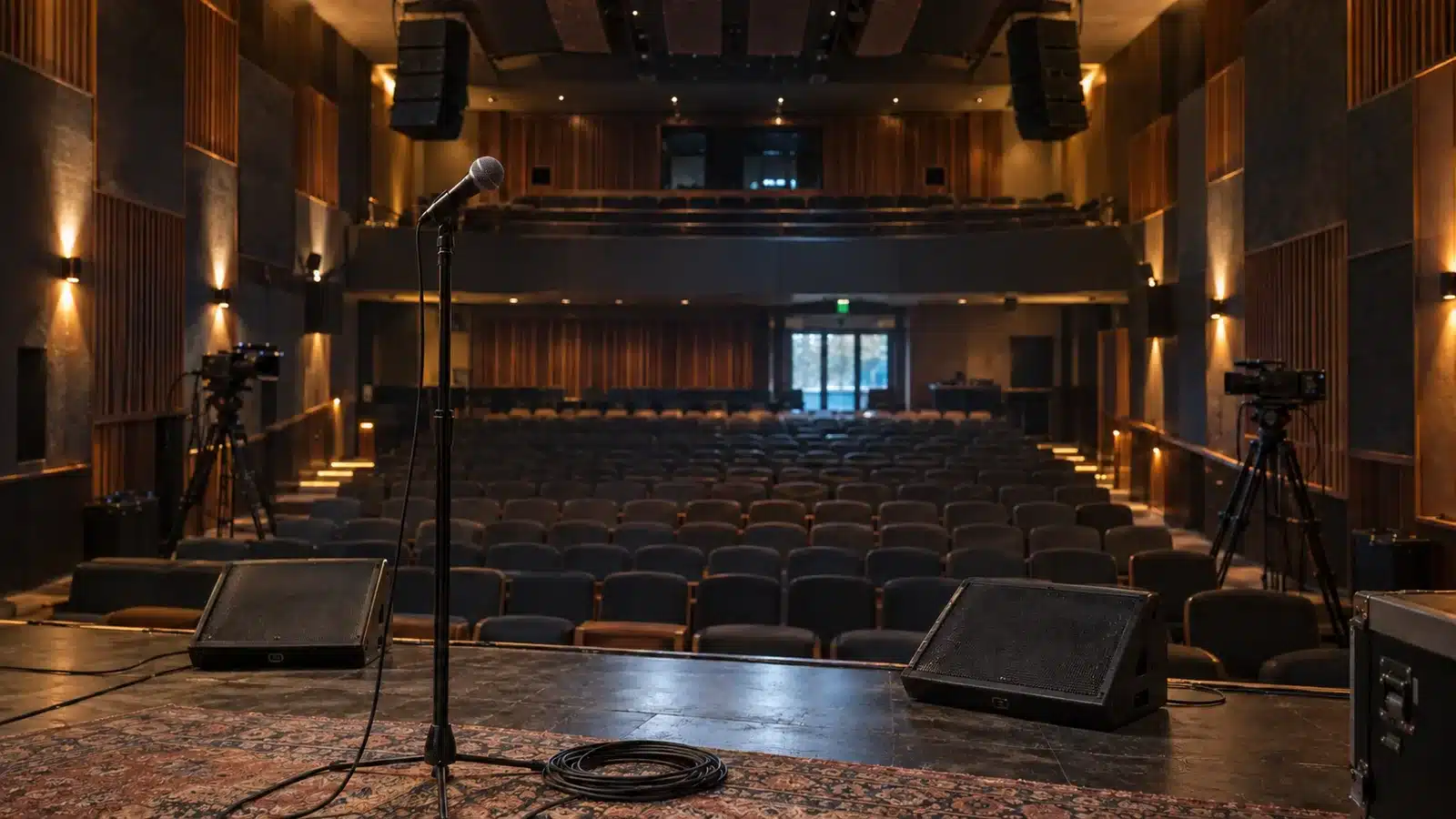
Apple Music Hall has been designed around a different idea. Announced on 21 September, the new 600-capacity venue inside London’s Battersea Power Station can host an intimate audience while recording multitrack audio, mixing in Spatial Audio, capturing multicamera video and livestreaming the same performance.
An artist can walk onto one stage and leave with the raw material for several kinds of release.
That makes the venue interesting for reasons beyond its technology. It shows how quickly the boundary between concert, recording session and media production is disappearing.
One Performance Can Become Many Different Things
Apple describes the hall as both a venue and a production facility. It contains two recording and mix studios, a 48-speaker spatial sound system and infrastructure for at least 16 cameras. The 38-foot stage can face forward or be rearranged for performances in the round.
That combination changes the purpose of the night.
The audience in the room still experiences a concert. Listeners elsewhere may watch a livestream. Later, the same performance could become a concert film, individual live videos, a broadcast special, social clips or an audio release mixed in stereo and Spatial Audio.
These outputs are not simply documentation. Each one gives the performance another life and asks the artist to make different editorial choices. A full concert preserves continuity. A single-song video creates a point of discovery. A live album asks whether the performance can stand beside the studio recording rather than merely illustrate it.
The stage is no longer only where the campaign arrives after a release. It can become a place where the next part of the catalogue is created.
Intimacy and Scale No Longer Have to Be Opposites
Large concert recordings have traditionally required large productions. Camera positions, lighting, audio capture and broadcast facilities all add cost and complexity. Smaller shows may feel more personal, but often lack the technical infrastructure needed to preserve that feeling convincingly.
Apple Music Hall tries to combine the two. Six hundred people can create the energy of a real crowd without placing the performer at the far end of an arena. Meanwhile, the installed recording and camera systems remove some of the temporary machinery that can make a filmed concert feel like a television set with an audience attached.
This matters because intimacy is difficult to recreate after the fact. A close performance is shaped by the distance between artist and listener, the sound of the room and the way an audience responds to small gestures. Capturing those details requires more than placing a phone at the back of the venue.
Production value is useful when it protects the atmosphere rather than replacing it.
The Live Show Is Becoming Part of the Release Workflow
Recorded music campaigns often follow a familiar sequence. The studio master comes first. Videos, interviews and performances then build attention around it.
A venue built for simultaneous audio and visual capture allows those stages to overlap. An artist could introduce a song in front of a small audience, record the performance properly and distribute several versions of the moment while it still feels current.
Spatial Audio makes that overlap particularly clear. Apple’s delivery rules require a Dolby Atmos version to be created from genuine multitracks or stems made from multitracks. A stereo master cannot simply be enlarged after the event through automatic upmixing. Capturing the performance correctly at the venue therefore matters if it is expected to become an immersive release later.
The technical decision begins before the first note. Microphone placement, audience sound, stage arrangement and camera movement become part of the recording process rather than problems left for an editor to solve afterwards.
For artists, that can encourage a more connected form of planning. The live set, visual language and release strategy no longer need to exist as separate projects.
A Platform Is Moving Further Into the Room
In When a Playlist Becomes a Place, I explored what happens when a streaming platform turns an editorial identity into a physical event. Apple Music Hall takes the idea another step. The platform is not only bringing listeners together around music; it is building the room in which the performance can be produced, recorded and redistributed.
That creates obvious opportunities. Artists gain access to equipment and expertise that would be difficult to assemble independently. Fans outside London can experience a performance through a global livestream. A carefully captured show may continue reaching listeners long after the audience has gone home.
It also gives the platform influence across more parts of the creative chain. Apple can be venue, production partner, broadcaster, streaming service and editorial gatekeeper around the same performance.
The important question is not whether those roles should ever sit together. A well-supported artist may benefit enormously from the arrangement. The question is who receives access, which performances remain available and how much control artists retain over the recordings, edits and future uses.
A beautiful room does not make those decisions unimportant. It makes them easier to overlook.
More Content Is Not Automatically a Better Story
A sixteen-camera recording can produce an enormous amount of material from one evening. That does not mean every possible clip should be released.
Live performance has value because it unfolds with tension and continuity. A set builds; mistakes become part of the atmosphere; one song changes the meaning of the next. Dividing the show into dozens of short fragments may extend its visibility while weakening the experience that made it worth capturing.
Artists therefore need an editorial idea before they need a content plan. What is this performance meant to reveal that the studio recording cannot? Does the arrangement change? Is the audience part of the music? Should the viewer experience the complete set, or is one carefully chosen song the truest expression of the night?
The strongest live recording is not the one that generates the largest folder. It is the one that preserves a reason for the performance to exist.
Independent Artists Can Use the Principle Without the Building
Most independent artists will never have access to a purpose-built venue with installed Spatial Audio studios and a permanent broadcast control room. The useful idea does not depend on that scale.
A small show can still be planned as a creative source rather than a one-night obligation. Multitrack audio from the mixing desk, one or two well-placed cameras and a clear lighting plan may be enough to produce a compelling live session. Careful preparation matters more than covering every angle.
The artist also needs to settle practical details before recording begins. Performer permissions, songwriter information, audience notices and ownership of the captured material should not be reconstructed after the show. Someone must monitor the audio separately from the room mix, because sound that works for the audience may not work as a recording.
A release plan can remain modest. One complete song with excellent sound often communicates more than ten rushed clips. An audio version may reach listeners who would never watch a full concert film. A short behind-the-scenes piece can provide context without pretending to be the main event.
For electronic artists, this approach can be especially revealing. A live session can show how programmed material, transitions, controllers and performance choices create movement beyond the finished studio master. The recording becomes evidence of musicianship rather than a reproduction of the file listeners already know.
The Room Still Matters in a Streaming Culture
Apple Music Hall is a highly controlled environment built by one of the world’s largest technology companies. Its opening is not proof that every venue will become a broadcast studio.
It does, however, point towards a wider change. Streaming platforms increasingly want moments that cannot be reduced to another track in a catalogue. Live performance offers scarcity, atmosphere and human presence. Recording technology allows that moment to travel without pretending that the remote experience is identical to being there.
The most promising part of this model is not the number of cameras or speakers. It is the possibility that artists can treat performance, sound and storytelling as one piece of work.
The risk is that a concert becomes valuable only for the content it produces. If every glance, pause and audience response is judged by how well it can be repackaged, the room loses the freedom that makes live music different from a studio session.
A venue designed for recording should preserve that difference, not erase it.
When the Stage Becomes the Studio
The opening of Apple Music Hall places a microphone, a camera and a global distribution system inside the same room.
For artists, that can turn one carefully prepared performance into an unusually rich creative asset. For listeners, it can provide a closer and more considered alternative to the endless stream of informal clips that now surrounds live music.
The technology will matter most when it becomes quiet enough for the performance to remain central.
A concert should still feel as though something happened once. The opportunity is to let that moment travel further without taking away what made it alive.